


Cloudfinancials Review: Is Cloudfinancials Fraud or Legit?
Cloudfinancials.net is a financial/investment platform that has raised serious regulatory concerns. Its website (http://cloudfinancials.net/) is currently non-functional, and domain information remains untraceable. The platform lists its address as 390 Page Blvd, Springfield, MA 01152, reachable at 1-413-351-0647 or support@cloudfinancials.net, with no fax available.
Most critically, the U.S. Securities and Exchange Commission (SEC) has officially blacklisted Cloudfinancials.net, citing it as an unregistered/unlicensed entity illegally offering financial products and services. Investors are strongly advised to avoid engaging with this platform. Always verify a firm’s registration status before investing through SEC’s official resources at sec.gov.
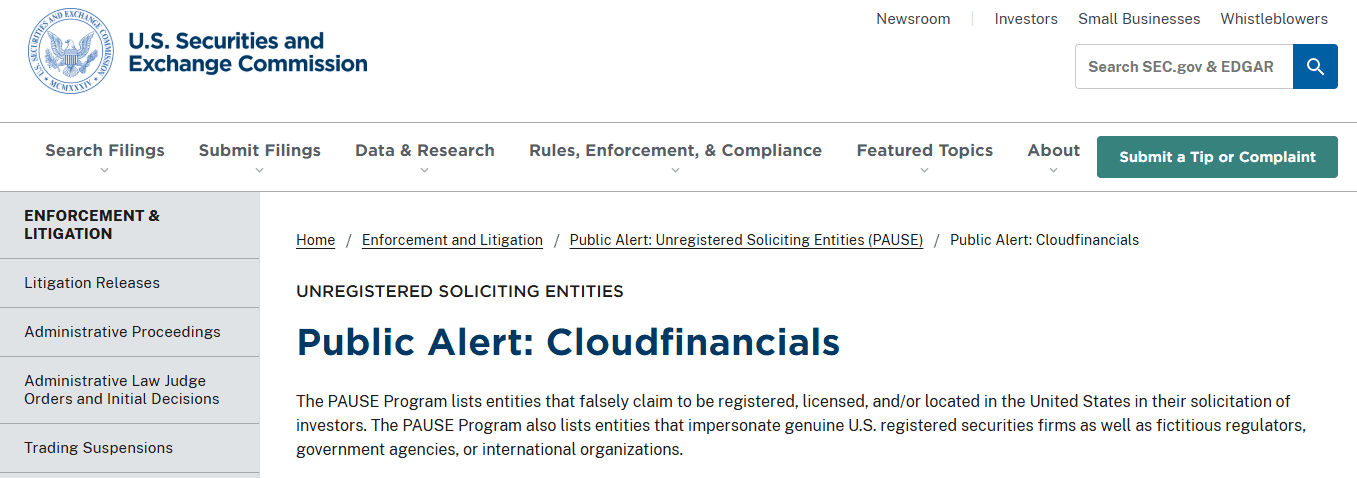
Is it really worth to trade with Cloudfinancials?
Recently, there have been several complaints against Cloudfinancials, and many Cloudfinancials customers have reported that their accounts were compromised by Cloudfinancials.net.
After a thorough analysis of regulations, the nature of business, Cloudfinancials.net website’s whois details, website content, Cloudfinancials’s withdrawal policies and other sensitive factors, we have flagged Cloudfinancials. Traders are advised to stay away from such brokers as their funds may be at risk.
Can Cloudfinancials Be Trusted?
The issue that raises immediate red flags when we analyse a broker is the total lack of registration with any reputable financial regulatory organisation. Legitimate investment platforms are required to be listed with bodies such as the FCA (UK), ASIC (Australia), SEC, or CFTC (United States). These organisations set strict standards, ensuring protection for consumers.
Without this oversight, users of Cloudfinancials have no legal safety net. There is no compensation scheme, no arbitration body, and no authority to hold the platform accountable. In the UK, for instance, only FCA-authorised firms are covered by the Financial Services Compensation Scheme or the Financial Ombudsman Service. In the US, protections offered through FINRA and SIPC are similarly unavailable when dealing with unregistered entities.
This lack of accountability is not accidental — it is often by design.
The Long Con: Relationship-Based
Platforms initiate contact through social media, dating apps, or messaging platforms, spending days or weeks cultivating trust before ever mentioning money. By the time an “investment opportunity” is introduced, the victim feels a genuine bond, making skepticism much harder.
The platform they’re directed to is entirely fake, designed to show fabricated profits while quietly holding funds hostage.
Counterfeit Trading Platforms
Victims are shown polished dashboards, realistic price charts, live chat agents, and even early withdrawal wins — all engineered to manufacture credibility. The moment larger sums are deposited, communication often breaks down, and funds become inaccessible.
Warning Signs to Watch For
- Unsolicited Contact — Unexpected messages offering investment tips or opportunities should raise immediate suspicion.
- No Verifiable License — Always check whether a platform is registered with a legitimate financial regulator before depositing anything.
- Guaranteed Returns — No legitimate investment can promise fixed daily profits. This claim alone is a red flag.
- Withdrawal Restrictions — If you’re asked to pay fees, taxes, or “verification charges” before accessing your own funds, you are likely being scammed further.
- Fabricated Social Proof — Fake testimonials, doctored news coverage, and alleged celebrity endorsements are commonly used to create a false sense of legitimacy.
What to Do If Cloudfinancials Has Taken Your Money?
- Cut Off All Communication — High-risk platforms frequently attempt follow-up schemes disguised as recovery assistance. Do not engage further.
- Alert Your Financial Institution — Contact your bank, card provider, or payment platform immediately to report unauthorized transactions.
- Preserve All Evidence — Save every message, screenshot, transaction record, and email connected to the platform. This documentation is essential for any formal investigation.
- File Official Reports — Submit a complaint to your national cybercrime authority, local law enforcement, and relevant international registries.
How Unregulated Online Investment Works?
Platforms like FastoxTrade typically rely on a series of well-documented deception tactics. Recognizing them is the first step toward protecting yourself.
The Long Con: Relationship-Based
Some of the most damaging issues begin not with a financial pitch, but with a personal connection. Platforms initiate contact through social media, dating apps, or messaging platforms, spending days or weeks cultivating trust before ever mentioning money. By the time an “investment opportunity” is introduced, the victim feels a genuine bond, making skepticism much harder.
The platform they’re directed to is entirely fake, designed to show fabricated profits while quietly holding funds hostage.
Counterfeit Trading Platforms
Victims are shown polished dashboards, realistic price charts, live chat agents, and even early withdrawal wins — all engineered to manufacture credibility. The moment larger sums are deposited, communication often breaks down, and funds become inaccessible.
What to Do If Cloudfinancials Has Taken Your Money?
File Official Reports — Submit a complaint to your national cybercrime authority, local law enforcement, and relevant international registries.
Cut Off All Communication — High-risk platforms frequently attempt follow-up schemes disguised as recovery assistance. Do not engage further.
Alert Your Financial Institution — Contact your bank, card provider, or payment platform immediately to report unauthorized transactions.
Preserve All Evidence — Save every message, screenshot, transaction record, and email connected to the platform. This documentation is essential for any formal investigation.

How Online Investment Fraud Works?
Fraudulent platforms like Cloudfinancials typically rely on a series of well-documented deception tactics. Recognizing them is the first step toward protecting yourself.
The Long Con: Relationship-Based Fraud
Some of the most damaging scams begin not with a financial pitch, but with a personal connection. Fraudsters initiate contact through social media, dating apps, or messaging platforms, spending days or weeks cultivating trust before ever mentioning money. By the time an “investment opportunity” is introduced, the victim feels a genuine bond, making skepticism much harder.
The platform they’re directed to is entirely fake, designed to show fabricated profits while quietly holding funds hostage.
Counterfeit Trading Platforms
Modern scam operations invest heavily in appearance. Victims are shown polished dashboards, realistic price charts, live chat agents, and even early withdrawal wins — all engineered to manufacture credibility. The moment larger sums are deposited, communication often breaks down, and funds become inaccessible.
Staying vigilant is your best defense. Always verify a platform’s regulatory standing before committing funds, and treat any promise of easy or guaranteed returns as the warning sign it is.ed in such tactics, its practices seem similar to those used in such cases.
Frequently Asked Questions
Q1: Is Cloudfinancials a regulated broker?
No. Cloudfinancials has no licensing or oversight from any recognized financial regulator, leaving investors without protection.
Q2: Why is Cloudfinancials flagged as a scam?
Multiple red flags are present: concealed ownership details, promises of unrealistic profits, withdrawal delays, and an overall lack of transparency.
Q3: What issues have users reported with Cloudfinancials?
Frequent complaints cover blocked withdrawals, pressure-based sales tactics, hidden charges, and unresponsive support.
Q4: Is it possible to recover money lost to Cloudfinancials?
It’s possible, though not guaranteed. Affected users are encouraged to consult cybercrime specialists or dedicated recovery support services.
How to Protect Yourself
Before depositing money into an account, always check for the broker’s licensing. This is because all legitimate financial trading platforms have their licenses published on websites run by the financial regulatory organizations. Therefore, if you notice that the broker does not have a legitimate license, refrain from making any payments, irrespective of the high returns being offered.
Note: Any form of financial fraud by Cloudfinancials can be reported anonymously to the relevant cybercrime investigators. Providing the details regarding the scam will ensure that others are also saved from financial fraud worldwide.
Final Thoughts – Is Cloudfinancials Broker Legit?
This Cloudfinancials review highlights patterns that could be consistent with high-risk or scam-like operations. While not every issue confirms wrongdoing, the lack of transparency and regulation may make Cloudfinancials Broker an unsafe choice for traders.
| ℹ️ As a Legal Recovery Consultants, we provide professional consultation for people who encounter issues due to the work of unauthorized brokers. If you face difficulties recovering your money or feel that you’ve been scammed, you may report your issue through the Legal Certifi platform. There, a panel of experts will advise you on how to act. |
Need Help Recovering Funds from Cloudfinancials?
Don’t worry if you have been scammed by Cloudfinancials or another scam brokerage, because you are not alone. To assist you in your fund recovery, we provide fund recovery services, legal advice, and support at LegalCertifi.com. Contact us now to initiate your justice.
To receive current updates, you can follow us, receive expert opinions and warnings about scams, please join us on:


Leave a Reply